Production deployedUsed by broadcast and IPTV operators in the EU
Four input familiesUDP, SRT, HTTP TS and HLS
Standards firstDVB and MPEG-TS correctness in the packet path
One Linux serviceEngine, API, UI, telemetry and HLS origin
Capabilities
From wire ingest to viewer delivery.
NoSignal covers the complete transport workflow while keeping protocol correctness, steady-state CPU use and operational clarity visible in the design.
01 · INGESTMultiple transport inputs
UDP multicast, SRT, HTTP transport stream and HLS inputs, with interface-aware binding and health signals.
02 · FAILOVERControlled source switching
Priority inputs, warm standby, watchdogs, anti-flap behavior and auto-revert keep output stable through source failure.
03 · CONDITIONINGDVB-correct packet work
PID filtering and remap, PSI rewrite, continuity correction, service identity and optional CBR pacing.
04 · OUTPUTParallel delivery
UDP multicast, SRT, HTTP TS and built-in HLS outputs consume independently so one slow path cannot block another.
05 · EPGXMLTV and EIT workflows
EPG import, mapping, service-aware injection and tools for resolving identifier collisions across channel lineups.
06 · OPERATIONSTelemetry everywhere
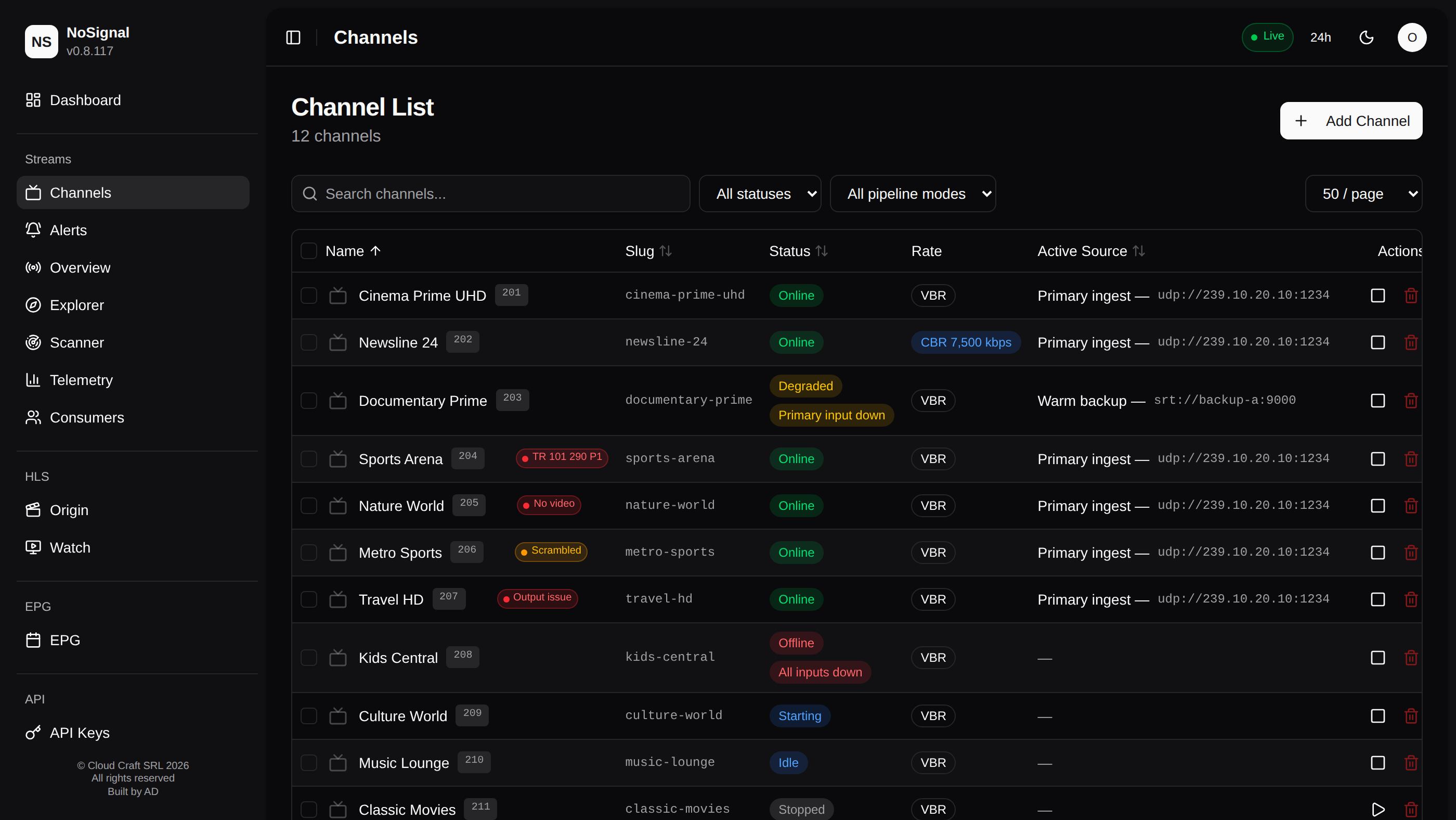
Web console, REST API, SSE state, Prometheus metrics, alerts, live preview and companion iOS visibility.
System shape
Async at the edges. Deterministic in the packet path.
Inputs and connection-oriented outputs use asynchronous I/O. The transform pipeline stays synchronous and allocation-light, while each channel remains an isolated runtime unit.
Transport inputsUDP · SRT · HTTP TS · HLS
Channel runtimeHealth, failover, packet pipeline
Output fan-outUDP · SRT · HTTP TS · HLS
OperationsWeb, API, SSE, Prometheus, iOS
What this proves
We build software where protocol details become operational outcomes.
NoSignal combines broadcast engineering, performance-sensitive Rust, Linux operations, a polished control surface and production deployment across real channel loads.
Broadcast engineeringMPEG-TS, DVB, multicast, SRT, HLS, EPG and receiver interoperability.
Performance architectureMinimal per-channel work, isolated tasks and predictable packet processing.
Product operationsInstaller, API, UI, licensing, telemetry, support tooling and release discipline.