Cloud Craft SRLCloud · DevOps · SRE · Infrastructure

Public BGP visibility · Internet Exchange

Give peers answers without giving the public a router shell.

BirdLG turns fresh route-server snapshots into a fast, read-only public Looking Glass. Peers can inspect sessions, route views and prefix reachability while production BIRD daemons remain isolated from public query traffic.

RustReactBGPRedisSSEIPv4 / IPv6
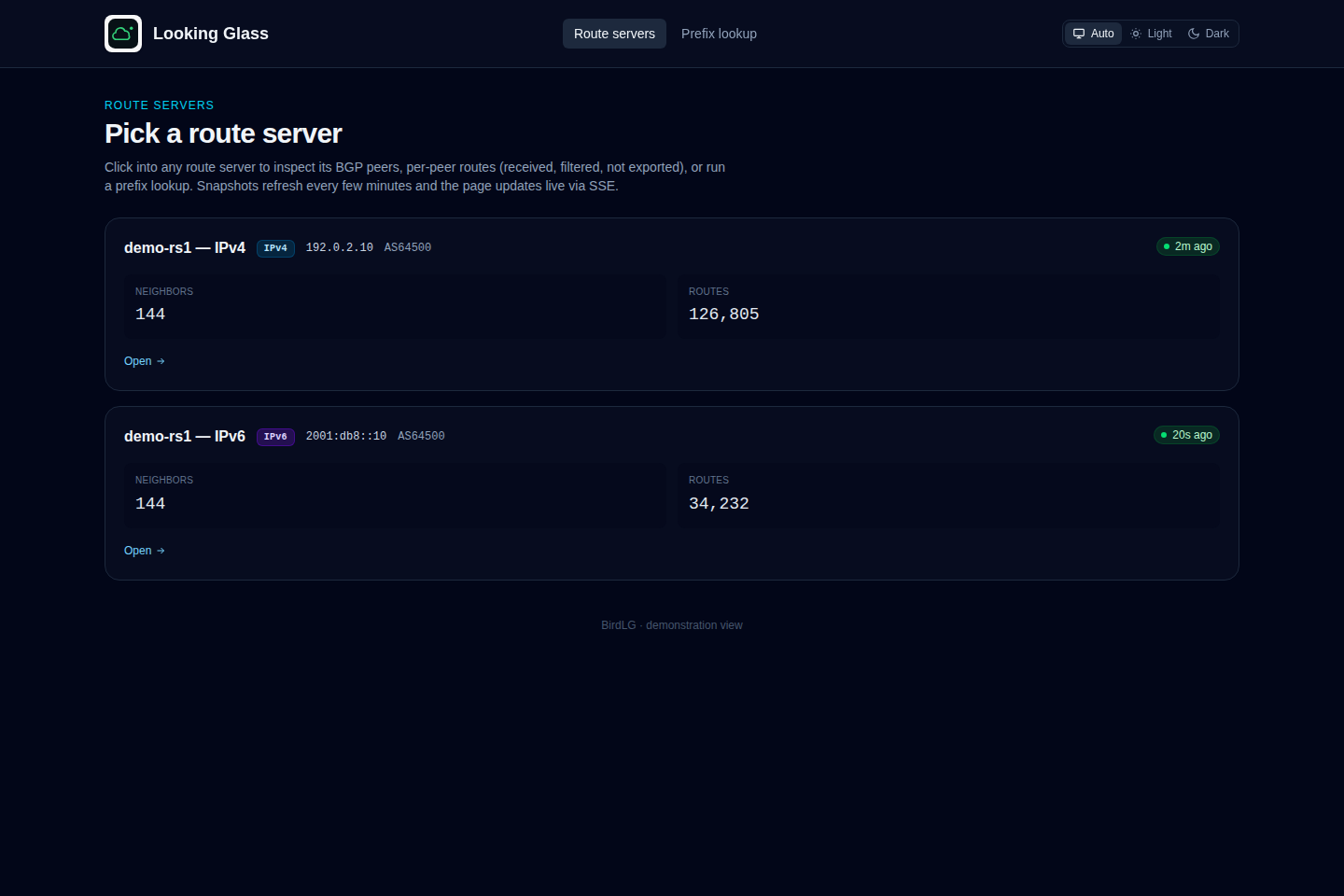
BirdLG route-server list with neutral demonstration branding, documentation-range addresses, route counts and freshness badges
Live product frontendOrganization, ASN and addresses replaced with demonstration values
No live router queriesPublic reads come from snapshots
Explicit freshnessFresh, stale, warming and expired states
Precise route viewsAccepted, filtered, exported, not-exported
Bounded public surfacePagination, caching and rate limits
Live and availableBirdLG runs as a public deployment. We deliver branded Looking Glass portals, snapshot and cache architecture, BIRD integrations, public APIs and operational handover.

The network problem

Peers need visibility, but operational systems need isolation.

A useful Looking Glass must explain what route servers see and advertise. Directly executing arbitrary commands against live routing processes creates an unnecessary availability and abuse boundary.

  • Public traffic must never compete with route-server control work
  • Cached data is only useful when freshness is visible and honest
  • Route states need exact vocabulary, not a single ambiguous “routes” view

The engineering response

Snapshot-driven, cache-backed and deliberately read-only.

Birdnest agents publish route and neighbor snapshots into Redis. BirdLG serves optimized indexes from that disposable cache, exposes explicit bucket age, and updates the interface through server-sent events.

  • Independent public service and rate-limit policy
  • Prefix and per-peer indexes avoid broad scans
  • EventSource updates freshness without aggressive polling

Capabilities

The useful questions, answered quickly.

The interface is deliberately small: choose a route server, inspect a peer, search a prefix, and understand how recent each underlying data bucket is.

01 · SERVERS

IPv4 and IPv6 overview

Route-server handles expose neighbor counts, route counts and snapshot age without leaking management detail.

02 · PEERS

Session inventory

Operators and peers can navigate neighbor state by route server, ASN and individual session context.

03 · ROUTES

Four exact route views

Accepted, filtered, exported and not-exported views preserve the distinction between import and export policy.

04 · LOOKUP

Prefix search

Indexed IPv4 and IPv6 lookups show relevant paths and peers without sending ad-hoc commands to BIRD.

05 · FRESHNESS

Per-bucket confidence

Full and filtered data can age independently, so the UI reports the state of the exact view being inspected.

06 · DELIVERY

Public-service discipline

Redis snapshots, bounded pages, API rate limits, caching and SSE make the site fast without compromising the control plane.

System shape

Public traffic never reaches BIRD directly.

The read path is intentionally one-way. Route-server agents capture data, Redis holds rebuildable snapshots, and the LG serves a narrow API and SPA.

BIRD route serversOperational routing state
Birdnest agentsBounded snapshots and freshness
Redis indexesDisposable, query-optimized cache
Public BirdLGRate-limited API and React UI

What this proves

A public network tool can be both useful and restrained.

BirdLG shows how Cloud Craft separates operational authority from customer-facing visibility while keeping freshness, performance and domain semantics first-class.

Customer and peer portalsClear public interfaces backed by deliberately limited APIs.
High-volume read pathsSnapshot design, indexes, caching, pagination and live UI updates.
Network-domain UXCorrect BGP concepts presented without forcing users to learn router CLI.

More projects

The systems behind and beside BirdLG.

Birdnest owns route-server intent and snapshots; Rerouter handles DDoS workflows; NoSignal applies the same operator-first approach to broadcast transport.

Visibility without overexposure

Need a public portal for complex infrastructure?

We design secure read paths, data snapshots, cached APIs and operator-grade interfaces for networks and other critical systems.