Cloud Craft SRLCloud · DevOps · SRE · Infrastructure

Internet Exchange infrastructure · BIRD 2

Preview BIRD policy before it reaches a route server.

Birdnest replaces a host-local Ruby generation chain with a central Rust control plane, deterministic BIRD 2 rendering, pull-based route-server agents, native IRR expansion, RPKI/RTR and a public Looking Glass.

RustReactBIRD 2IXPManagerIRRRPKI / RTR
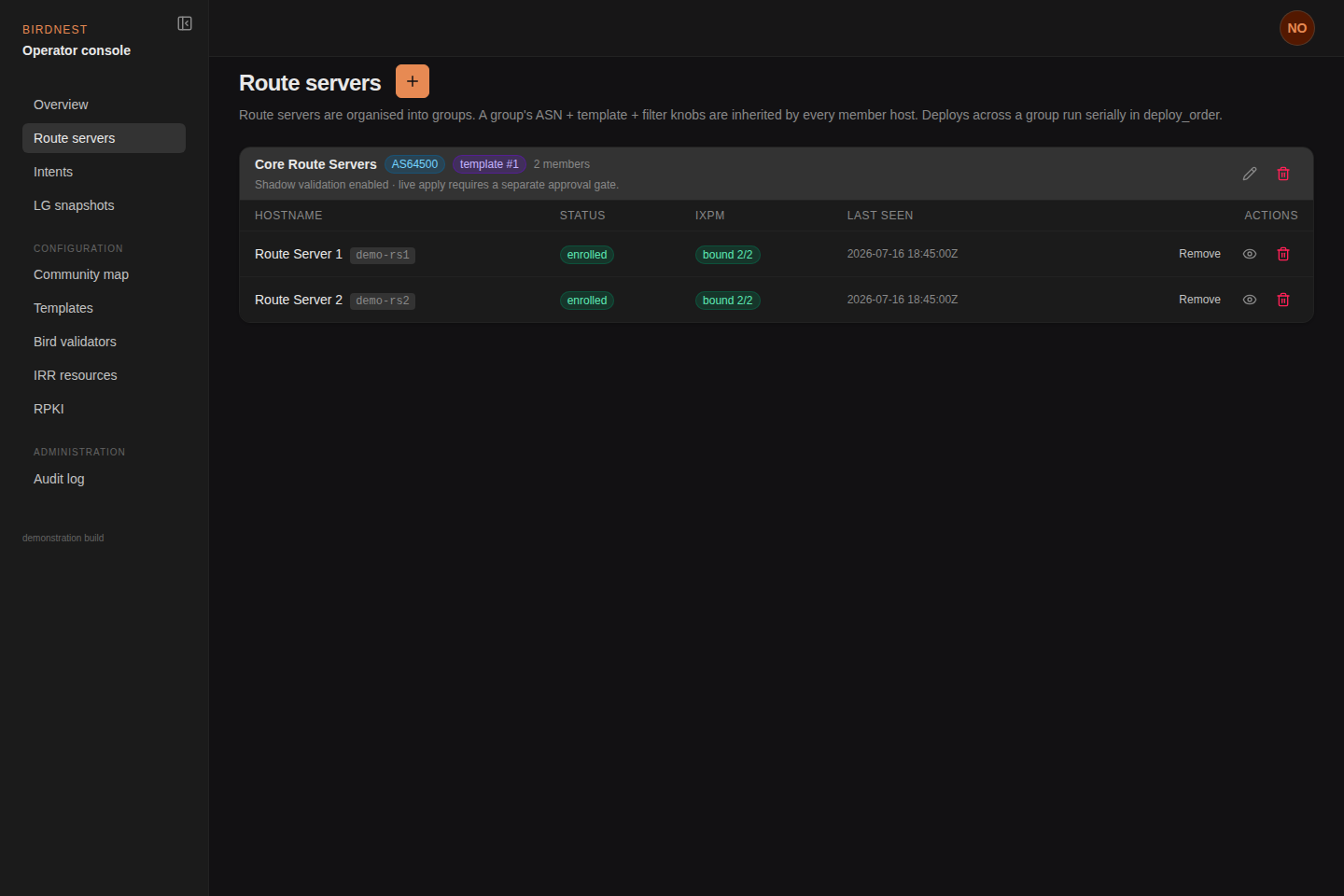
Birdnest operator console showing two enrolled route servers, healthy agent freshness and complete IXPManager bindings
Route-server operationsSanitized demo data · real frontend
Pull, not pushAgents request bounded work from the controller
Artifact identityIntent hash covers config and sidecars
Native policy dataIRRd client plus RPKI/RTR pipeline
Validate in sandboxBIRD parser and host-local safety gates
Current rollout stageProduction route-server inputs are in shadow validation; live apply remains deliberately gated. Available engagements include renderer migration, agent rollout, IRR/RPKI integration and public Looking Glass delivery.

The operator problem

Route-server configuration grows beyond the script that started it.

As an exchange grows, peer data, IRR policy, RPKI state, templates, generated sidecars, deployment and public visibility must agree. A render script alone cannot explain desired state, host drift or partial rollout.

  • Input data changes independently across multiple systems
  • Push deployment increases blast radius and host coupling
  • Policy changes need preview, validation and stable identity

The engineering response

Persisted intent, host-local validation and rebuildable visibility.

Birdnest makes MariaDB authoritative for control-plane state, uses pull agents on route-server hosts, validates generated artifacts with BIRD itself, and publishes route snapshots through a rebuildable Redis cache.

  • Controller loss does not stop already-running BIRD daemons
  • Sidecars and main configuration share one content identity
  • Current production posture keeps live apply explicitly gated

Capabilities

Routing policy as an operational system.

Birdnest spans data integration, configuration compilers, distributed agents, routing security, public APIs and operator UX. The difficult parts are kept explicit instead of being hidden inside deployment glue.

01 · SOURCE

IXPManager synchronization

Reads peer and route-server data without writing upstream, then binds imported identities to controlled local intent.

02 · RENDER

Deterministic BIRD artifacts

Tera-based rendering produces main configuration and sidecars with stable ordering, preview and full artifact hashing.

03 · AGENTS

Pull-based host control

Bearer-enrolled agents poll for work, validate locally, maintain snapshots and report bounded results to the controller.

04 · POLICY

Native IRR expansion

An in-process IRRd protocol client resolves AS-SETs and emits lossless BIRD prefix patterns without shelling out.

05 · ROUTING SECURITY

RPKI and RFC 8210 RTR

A native relying-party pipeline retains last-good data and serves validated origin payloads directly to BIRD.

06 · VISIBILITY

Fresh route snapshots

Agent-fed neighbor and route views power a public, rate-limited Looking Glass with per-bucket freshness.

System shape

Control stays central. Validation stays close to BIRD.

The controller owns intent and orchestration, while each Linux host owns the final parse check and filesystem boundary. Public route visibility is separated from authoritative state.

IXPManager + IRRPeer source and routing policy data
Birdnest controllerRender, intent, audit, orchestration
Pull agentFetch, sandbox, bird -p, report
BIRD + LGRoute servers, RTR and snapshots

What this proves

We understand both the protocol and the operating model.

Reliable routing automation needs more than BGP vocabulary. It needs correct configuration semantics, safe distribution, observability, recovery and an interface that lets operators challenge the system.

Internet Exchange engineeringRoute servers, peer data, BIRD, IXPManager and public Looking Glass workflows.
Distributed control planesIntent identity, pull agents, bounded work, sandbox validation and drift-aware reporting.
Routing securityIRR policy, RPKI validation, RTR distribution and last-good operational behavior.

More projects

Related engineering systems.

Explore the public route view, DDoS mitigation control plane, and our broadcast transport product.

Routing systems that can be operated

Modernizing an exchange or BGP platform?

We can help with BIRD architecture, policy data, route-server automation, migration from host-local scripts, validation gates, RPKI/RTR and operator tooling.